Project management is not a one-size-fits-all discipline. Choosing the right project management approach can be the difference between a successful delivery and a failed initiative. As organizations face rapid change, tighter budgets, and higher stakeholder expectations, understanding different types of project management methodologies has become a core professional skill. In this guide, we explain the types of project management used by modern organizations and how professionals apply them in real projects.
In this guide, we’ll clearly explain the most widely used project management approaches, when to use them, and how modern project managers apply them in real-world environments.
What Is a Project Management Methodology?
A project management methodology is a structured framework that defines how a project is planned, executed, monitored, and closed. Each methodology provides guidance on:
- How work is organized
- How teams collaborate
- How risks and changes are handled
- How success is measured
Professional project managers don’t blindly follow a single method. Instead, they select or adapt methodologies based on project complexity, industry requirements, and stakeholder needs.
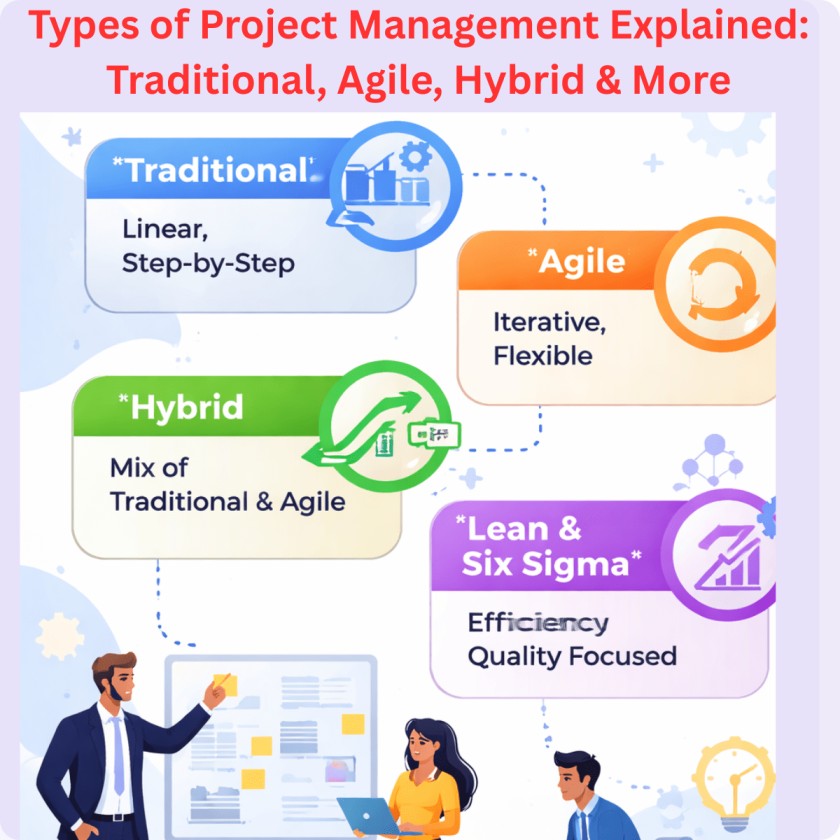
1. Traditional Project Management (Waterfall)
Traditional project management, often referred to as the Waterfall approach, follows a linear and sequential structure. Each phase must be completed before the next one begins.
Key Characteristics
- Clearly defined scope and requirements
- Fixed timelines and budgets
- Extensive upfront planning
- Formal documentation and approvals
Best Used When
- Requirements are stable and well-understood
- Regulatory or compliance constraints exist
- Changes are costly or risky
Common Industries
Construction, manufacturing, engineering, infrastructure, government projects
📌 Limitations:
Traditional methods struggle in fast-changing environments where requirements evolve frequently.
2. Agile Types of Project Management
Agile project management focuses on adaptability, collaboration, and delivering value in small increments. Instead of planning everything upfront, Agile teams work in short cycles and continuously refine outcomes.
Key Characteristics
- Iterative development
- Frequent stakeholder feedback
- Cross-functional teams
- Emphasis on working deliverables
Best Used When
- Requirements are uncertain or evolving
- Speed and flexibility are critical
- Continuous customer involvement is possible
Common Frameworks
Scrum, Kanban, XP (Extreme Programming)
📌 Limitations:
Agile can be challenging in highly regulated environments or where stakeholders expect fixed scope and cost upfront.
3. Hybrid Project Management
Hybrid project management combines elements of both Traditional and Agile approaches. It has become one of the fastest-growing models in enterprise environments.
Key Characteristics
- Structured planning with flexible execution
- Fixed milestones with iterative development
- Balance between governance and adaptability
Best Used When
- Organizations are transitioning from Waterfall to Agile
- Some parts of the project require stability, while others need flexibility
- Multiple teams follow different working styles
Common Use Cases
Enterprise IT programs, digital transformation, large-scale system implementations
📌 Why it’s popular:
Hybrid allows organizations to modernize without abandoning governance and control.
Understanding the different types of project management helps professionals select the right approach based on risk, scope, and delivery expectations.
4. Lean Types of Project Management
Lean project management focuses on maximizing value while minimizing waste. It originated from manufacturing but is now widely applied across industries.
Key Characteristics
- Focus on efficiency and flow
- Elimination of non-value-added activities
- Continuous improvement mindset
- Strong customer-value orientation
Best Used When
- Process optimization is critical
- Speed and efficiency are top priorities
- Teams want to reduce delays and rework
Common Industries
Operations, manufacturing, healthcare, supply chain, service delivery
📌 Core principle:
Do more with less—without sacrificing quality.
5. Six Sigma Project Management Types
Six Sigma is a data-driven approach aimed at improving quality by reducing defects and variation in processes.
Key Characteristics
- Statistical analysis
- Defined improvement cycles (DMAIC)
- Strong focus on measurable outcomes
- Emphasis on process consistency
Best Used When
- Quality issues directly impact cost or customer satisfaction
- Processes are repetitive and measurable
- Data is available for analysis
Common Industries
Manufacturing, healthcare, finance, operations
📌 Often combined with Lean:
Lean Six Sigma blends efficiency with quality improvement.
6. Adaptive and Iterative Approaches
Beyond Agile, many organizations use adaptive or iterative project management, where learning from each cycle shapes future decisions.
Key Characteristics
- Incremental planning
- Continuous learning
- Risk reduction through early delivery
Best Used When
- Innovation or research is involved
- Outcomes cannot be fully defined upfront
- Experimentation is encouraged
How Do Project Managers Choose the Right Approach?
Experienced project managers consider multiple factors before selecting a methodology:
- Project size and complexity
- Risk level and uncertainty
- Regulatory requirements
- Stakeholder expectations
- Team maturity and skills
This decision-making ability is a core competency tested in professional certifications like PMP®, which emphasize tailoring approaches rather than rigidly applying a single method.
Why Understanding Multiple Methodologies Matters
Modern project managers are expected to:
- Speak the language of different frameworks
- Adapt methods to real-world constraints
- Lead diverse teams across industries
- Deliver value, not just documentation
Organizations increasingly value professionals who can blend methodologies intelligently, not just follow textbook definitions.
Final Thoughts
There is no “best” project management methodology—only the best approach for a specific project. Traditional, Agile, Hybrid, Lean, and Six Sigma each serve a purpose when applied correctly.
Successful project managers focus less on labels and more on outcomes, adaptability, and leadership. Understanding these methodologies empowers you to make informed decisions, lead confidently, and deliver results in any environment.
PMP® is a registered trademark of the Project Management Institute, Inc.