
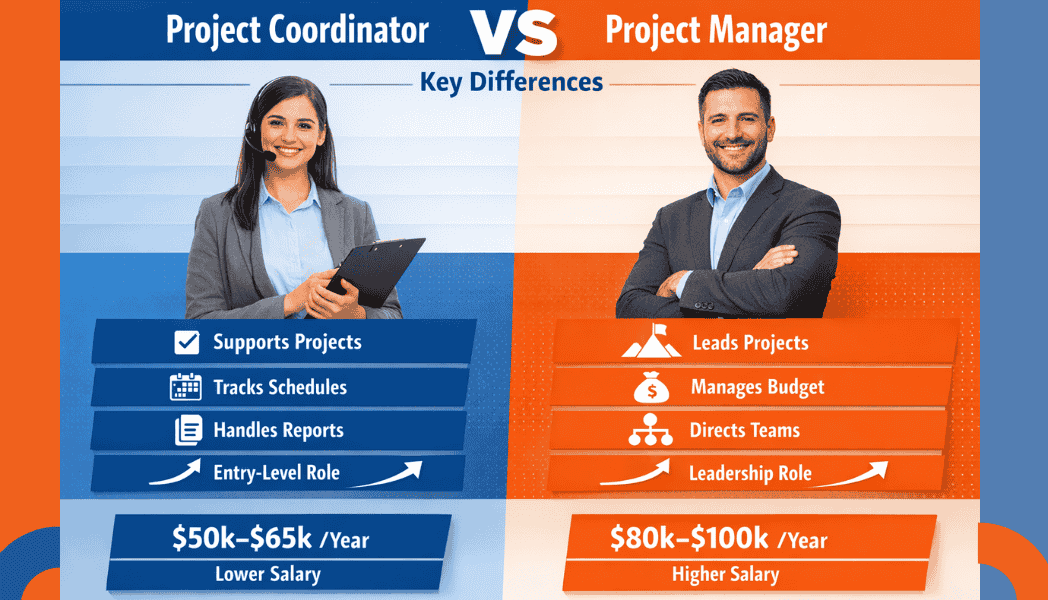
The Project Manager vs Project Coordinator comparison is one of the most searched topics in project management careers. Although both roles contribute to successful project delivery, their authority, accountability, and leadership levels differ significantly. Therefore, understanding the difference between a Project Manager and a Project Coordinator helps professionals choose the right career path with clarity and confidence.
What Is the Difference Between a Project Manager and Project Coordinator?
At a high level, both roles aim to deliver projects successfully. However, their scope of responsibility and decision-making power vary considerably.
A Project Manager leads the entire project and holds accountability for scope, schedule, cost, quality, and risk. In contrast, a Project Coordinator provides operational and administrative support to ensure the project runs smoothly.
Moreover, while the Project Manager makes strategic decisions, the Project Coordinator focuses on coordination, reporting, and documentation. As a result, ownership and authority clearly separate these two positions.
Understanding the Role of a Project Coordinator
Within the project management structure, the Project Coordinator plays a crucial support role. Essentially, this position acts as the operational backbone that keeps communication, schedules, and documentation aligned.
Rather than leading strategic decisions, the Coordinator ensures processes are followed correctly and consistently. Consequently, the team stays organized and informed throughout the project lifecycle
Key Responsibilities of a Project Coordinator
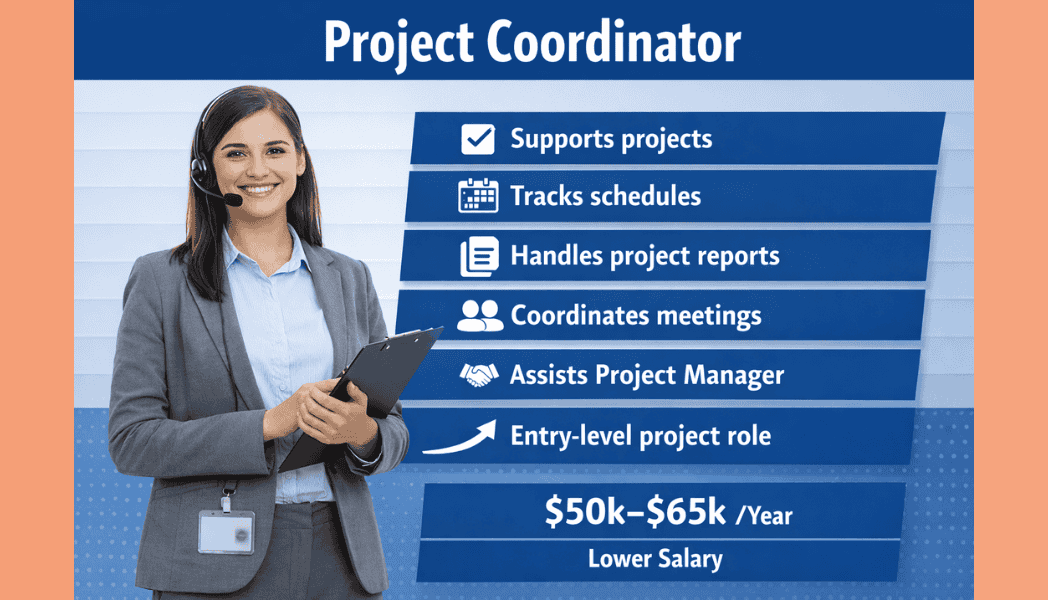
Typically, a Project Coordinator focuses on execution support. Responsibilities often include:
- Tracking project schedules
- Preparing status reports
- Coordinating meetings
- Maintaining documentation
- Supporting communication flow
- Assisting the Project Manager
Because of this structured support, the Project Manager can concentrate on high-level planning and stakeholder management.
Where the Project Coordinator Adds Value
From practical experience, a strong Project Coordinator:
- Improves overall project visibility
- Reduces the administrative burden on the Project Manager
- Ensures documentation accuracy
- Strengthens communication between stakeholders
For this reason, the role is ideal for professionals entering the project management field or transitioning from operations into structured project environments.
Understanding the Role of a Project Manager
In comparison, the Project Manager carries full accountability for delivering results. This includes completing the project on time, within scope, and within budget.
Unlike a Coordinator, a Project Manager holds decision-making authority and manages stakeholder expectations directly. Therefore, success or failure ultimately rests with the Project Manager.
Key Responsibilities of a Project Manager
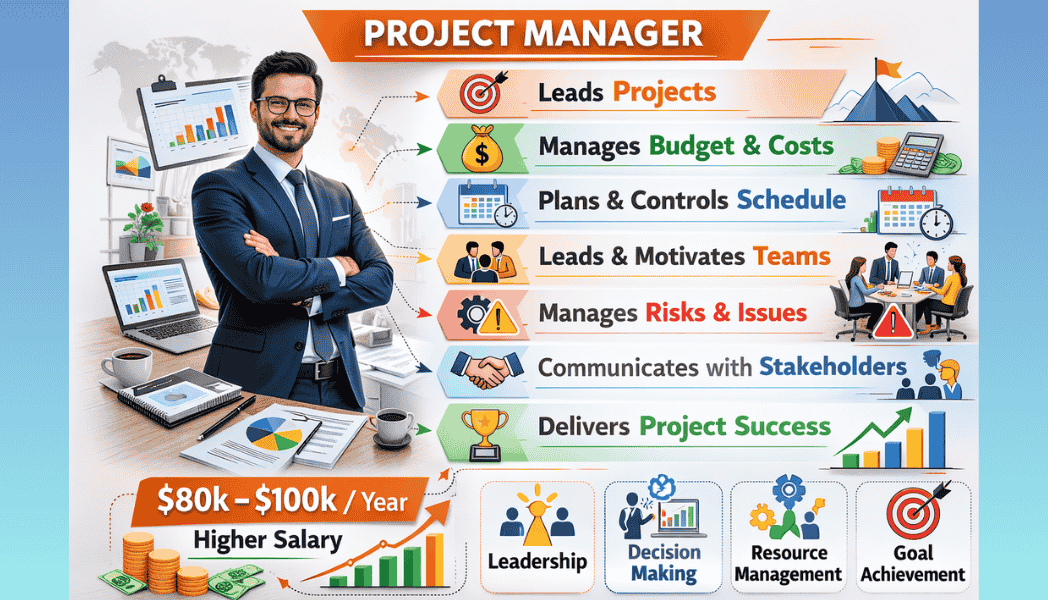
The Project Manager’s responsibilities extend across the entire project lifecycle, including
- Defining project scope and objectives
- Developing the project management plan
- Managing budget and resources
- Leading cross-functional teams
- Identifying and mitigating risks
- Managing stakeholder engagement
- Ensuring delivery and benefits realization
As a result, leadership capability becomes essential in this role.
Leadership Level: Project Manager vs Project Coordinator
Leadership represents one of the most important distinctions in the Project Manager vs Project Coordinator discussion.
Project Managers directly lead teams, resolve conflicts, and drive strategic decisions. Meanwhile, Project Coordinators facilitate communication and maintain alignment across stakeholders. Consequently, the Manager operates at a higher authority level, while the Coordinator functions in a support capacity.
Career Path: From Project Coordinator to Project Manager
Many professionals begin their journey as Project Coordinators. Over time, they gain exposure to reporting, planning, budgeting basics, and stakeholder communication.
Eventually, this experience builds the foundation necessary for a Project Manager role. In addition, certifications such as PMP® significantly accelerate this transition.
Career progression often follows this path:
Project Coordinator → Assistant Project Manager → Project Manager → Senior Project Manager → Program Manager
Thus, the Coordinator role frequently serves as a stepping stone toward leadership.
Salary Comparison: Project Manager vs Project Coordinator
Compensation typically reflects responsibility and accountability.
In most industries, Project Managers earn higher salaries because they manage budgets, risks, and delivery outcomes. On the other hand, Project Coordinators receive entry-level to mid-level compensation due to their support-focused duties.
For example, salary data in the United States and Canada consistently shows a noticeable pay gap between these two roles. Therefore, career advancement directly impacts earning potential.
In the USA and Canada: Find the U.S. Bureau of Labor Statistics
- Project Coordinators typically earn entry-to-mid level compensation
- Project Managers command significantly higher salaries due to delivery accountability
Career progression often follows this path:
Project Coordinator → Assistant Project Manager → Project Manager → Senior PM → Program Manager
Skills Required: Project Coordinator vs Project Manager
Skills for a Project Coordinator
A successful Project Coordinator usually demonstrates
- Organizational skills
- Communication skills
- Documentation and reporting
- MS Project / Excel proficiency
- Attention to detail
These skills ensure structured execution and operational efficiency.
Skills for a Project Manager
In contrast, a Project Manager must combine technical knowledge with leadership strength. Core skills include:
- Leadership and decision-making
- Risk management
- Budget management
- Stakeholder engagement
- Negotiation skills
- Strategic thinking
Without these competencies, managing complex projects becomes difficult.
Certification Path: Project Coordinator vs Project Manager
If career growth is your goal, certifications play a major role.
For Project Coordinators
For Project Managers
- PMP® (Project Management Professional)
- PMI-ACP®
- PRINCE2®
- Lean Six Sigma
Because employers increasingly value certified professionals, credentials often accelerate career progression — especially in competitive markets like the USA and Canada.
My Ground-Level Perspective
Based on real-world observation:
A Project Coordinator ensures the engine runs smoothly.
In contrast, a Project Manager decides where the vehicle is going.
Both roles are essential. However, long-term career growth requires moving from support to ownership.
The transition happens when you shift from:
Tracking tasks → Owning outcomes
Reporting risks → Managing risks
Scheduling meetings → Leading meetings
Supporting delivery → Delivering results
Ultimately, that mindset shift defines true promotion.
Which Role Is Right for You?
Before choosing between a Project Manager and Project Coordinator career path, consider the following:
- Do you prefer structured coordination or strategic decision-making?
- Are you comfortable leading teams and managing conflict?
- Would you rather support delivery or own final results?
If you are early in your career, beginning as a Project Coordinator builds a solid foundation. However, if leadership and accountability excite you, pursuing a Project Manager role should be your long-term objective.
Final Thoughts: Project Coordinator vs Project Manager
The difference between a Project Manager and a Project Coordinator extends beyond job titles. It reflects variations in ownership, authority, and strategic impact.
Although both roles contribute significantly to project success, the leap to Project Manager requires stepping into accountability and leadership. Therefore, professionals aiming to advance should focus on developing decision-making ability, earning certifications, and gradually taking ownership of outcomes — even before receiving the title.
For many ambitious professionals, pursuing PMP certification training becomes the turning point in transitioning from Project Coordinator to Project Manager.