
PMI-PBA Certification Training
Categories
Agile and Project Management
$99 – $2,499Price range: $99 through $2,499
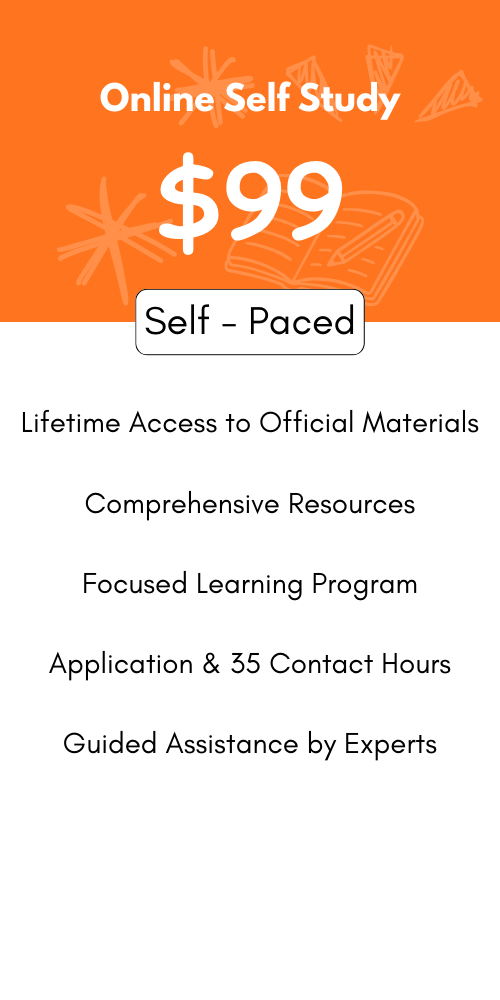
$99
-
LevelIntermediate
-
Last UpdatedMarch 3, 2026
Hi, Welcome back!
Pre-Requisites
- Eligibility / Prerequisites (as defined for PMI-PBA® exam)
- You must meet one of the following eligibility paths:
- Option 1
- Secondary degree (high school diploma or associate degree)
- 60 months of business analysis experience
- 35 contact hours of education in business analysis
- OR
- Option 2
- Bachelor’s degree (or global equivalent)
- 36 months of business analysis experience
- 35 contact hours of education in business analysis
- Exam & Certification Details
- Number of questions: 200
- Exam duration: 4 hours
- Passing score: Not specified by PMI
- Exam type: Closed-book
- Examination fee
- PMI members: USD 405
- Non-members: USD 555
- Course Instructions
- Attend the full 32-hour bootcamp to earn the 35 contact hours certificate
- Use the provided e-learning modules, case studies, and practice tests for revision
- Apply for the PMI-PBA® exam with the help of the Certification Guide application support team
- A stable internet connection is required for live online sessions
- Learners are encouraged to bring real project or business scenarios for better practical learning
- This training fully prepares you to meet PMI-PBA® eligibility requirements and confidently appear for the certification exam.
Who Should Enroll
- Business analysts and aspiring business analysts
- Project managers and project management professionals
- Product owners and product managers
- Consultants and solution analysts
- Professionals involved in requirements gathering, process improvement, and business transformation
- Anyone planning to pursue the PMI-PBA® certification
Courseware Includes
- 32 hours of intensive PMI-PBA bootcamp training
- Instructor-led live online or classroom sessions
- 35 contact hours certificate
- 100 days of e-learning access
- Case studies and practice tests
- Real-life examples delivered by industry experts
- Highly experienced instructors
- PMI-PBA exam application assistance and post-workshop support
- 24/7 customer support
- 100% class-run guarantee
- 100% money-back guarantee


Description
The PMI-PBA® Certification Training by Certification Guide is a comprehensive 4-day bootcamp designed to help professionals build strong business analysis skills and prepare for the PMI-PBA® certification exam. This program focuses on the real-world role of a Business Analyst and covers the tools, techniques, and practices required to identify business needs, assess risks, and deliver sustainable solutions.
This certification is offered by the Project Management Institute and is globally recognized for validating a professional’s expertise and credibility in business analysis and project environments.
Participants gain hands-on exposure through projects, case studies, and expert-led sessions in both live online and classroom modes.
What I will learn?
- Understand the role and responsibilities of a Business Analyst
- Learn core business analysis concepts, tools, and techniques
- Identify business needs, risks, and opportunities
- Define and analyze business and stakeholder requirements
- Support project teams with structured business analysis practices
- Create sustainable and value-driven business solutions
- Apply business analysis techniques in real-life project scenarios
- Prepare effectively for the PMI-PBA® certification exam
Course Agenda
Introduction to Business Analysis
-
Definition, Role, Requirements, Methodologies
-
Project Management Institute’s (PMI)® Code of Ethics
Needs Assessment (this section comprises 18 percent of the Exam)
-
Defining Business Problems or Opportunities and Developing a Solutions Scope Statement or Business Case
-
Determining the Value Proposition of the Initiative
-
Identifying Business Needs and Developing Project Goals and Objectives
-
Identifying Stakeholders and Stakeholder Values
Planning (this section comprises 22 percent of the Exam)
-
Establishing Business Analysis Activities
-
Defining strategy for Requirements Traceability
-
Defining Requirements Change Control and Communication Processes
-
Selecting methods for Requirements Change Control, and Document Control Processes
-
Defining Business Metrics and Acceptance Criteria
Analysis (this section comprises 35 percent of the Exam)
-
Eliciting and Identifying Requirements
-
Analyzing, Decomposing, and Elaborating Requirements
-
Evaluating Options and Capabilities using Decision-Making
-
Allocating Requirements to Create a Requirements Baseline
-
Obtaining Stakeholder Consensus in order to Obtain Sign-off
-
Defining Requirements Specifications
-
Validating Requirements using Tools and Techniques
-
Detailing out Business Metrics and Acceptance Criteria
Traceability and Monitoring (this section comprises 15 percent of the Exam)
-
Tracking the Status, Sources, and Relationships of Requirements using Artifacts or Tools
-
Monitoring the Lifecycle of Requirements
-
Updating the Status of Requirements and Recording Changes by Communicating with Stakeholders
-
Communicating Important Requirements Information and Status with Stakeholders and Project Managers
-
Managing Changes to the Requirements by evaluating Impacts, Dependencies and Risks
Evaluation (this section comprises 10 percent of the Exam)
-
Validating Solutions Test Results against Defined Requirements Acceptance Criteria
-
Analyzing, Communicating, and Resolving Solution Gap Analysis
-
Obtaining Stakeholder Sign-off and Proceeding Toward Deployment
-
Using Valuation Techniques to Determine How Well the Solution Met Business Needs and Values
Student Ratings & Reviews

No Review Yet