
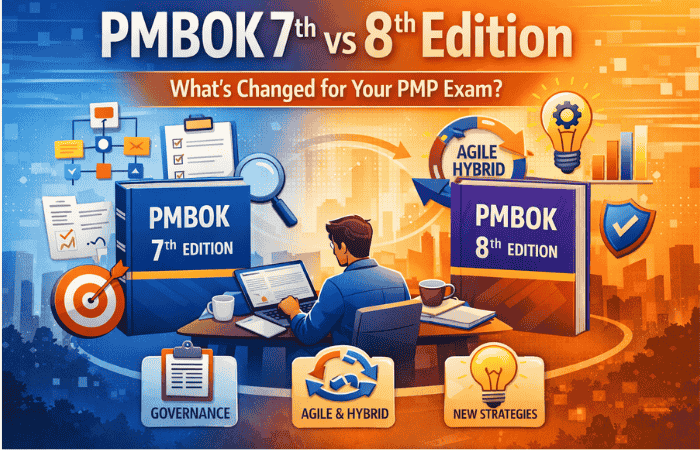
PMBOK Guide 7th vs 8th edition, The comparison between PMBOK 7th vs 8th is one of the most discussed topics among PMP aspirants and project management professionals. As standards evolve, understanding these updates becomes essential. Therefore, reviewing both editions carefully can significantly improve exam preparation and practical application.
Evolution of the PMBOK Framework
Previously, older PMBOK editions followed a strict process-based structure. However, PMBOK 7th marked a major shift toward a principle-based approach. Instead of focusing on 49 processes, it introduced 12 project management principles and 8 performance domains.
Subsequently, PMBOK 8th expanded this foundation. While it retains the principle-driven mindset, it strengthens governance alignment, enterprise integration, and practical tool categorization. As a result, the guide now reflects modern hybrid delivery environments more clearly.
Structural Comparison: PMBOK 7th vs 8th
When comparing PMBOK 7th vs 8th, several structural differences stand out.
1️⃣ Core Philosophy Shift
PMBOK 7th focuses on:
- 12 Project Management Principles
- 8 Performance Domains
- Value Delivery System
- Tailoring guidance
In contrast, PMBOK 8th enhances:
- Governance frameworks
- Enterprise strategy alignment
- Expanded tools and techniques
- Hybrid and adaptive delivery guidance
Although both editions emphasize flexibility, the 8th edition offers more operational depth.
2️⃣ Performance Domains in PMBOK Guide 7th vs 8th Edition
The 7th Edition introduced 8 Performance Domains:
- Stakeholder
- Team
- Development Approach
- Planning
- Project Work
- Delivery
- Measurement
- Uncertainty
The 8th Edition enhances these domains with:
- More detailed implementation strategies
- Enterprise PMO integration
- Governance oversight frameworks
- Advanced measurement models
3️⃣ Agile & Hybrid Updates in PMBOK Guide 7th vs 8th Edition
Both editions support predictive, agile, and hybrid approaches.
However:
- The 7th Edition introduced integrated agile thinking.
- The 8th Edition refines hybrid delivery models with clearer tailoring guidance.
For PMP exam preparation, hybrid project management questions are increasingly prominent, making the 8th Edition highly relevant.
4️⃣ Tailoring and Governance Enhancements
One of the biggest upgrades in PMBOK 8th Edition is structured tailoring guidance.
7th Edition
- Introduced the concept of tailoring
- Encouraged flexibility based on context
8th Edition
- Connects tailoring directly to governance models
- Clarifies decision authority structures
- Aligns project delivery with enterprise strategy
This is especially valuable for PMOs and large organizations.
5️⃣ Tools, Models, and Methods
| Feature | PMBOK 7th Edition | PMBOK 8th Edition |
|---|---|---|
| Framework | Principles-based | Principles + Practical Expansion |
| Tools & Techniques | High-level taxonomy | Expanded models & advanced practices |
| Case Studies | Limited | Broader real-world examples |
| Enterprise Focus | Emerging | Strong governance alignment |
| Hybrid Guidance | Introduced | Enhanced and clarified |
PMP Exam Impact of PMBOK Guide 7th vs 8th Edition
The PMP exam content outline evolves continuously. While both editions influence the exam:
- Performance domain thinking (7th) remains foundational.
- Governance, adaptive delivery, and hybrid frameworks (8th) are increasingly relevant.
- Situational and scenario-based questions align with 8th Edition principles.
For optimal PMP preparation:
Combine:
- PMBOK 7th Edition
- PMBOK 8th Edition
- Agile Practice Guide
- PMP Exam Content Outline
Should You Study PMBOK Guide 7th or 8th Edition?
Modern projects require:
- Cross-functional team leadership
- Adaptive planning
- Enterprise governance integration
- Value-driven delivery
- Hybrid framework alignment
The 8th Edition supports these realities more directly than previous versions.
Final Verdict: PMBOK 7th vs 8th Edition
✔ PMBOK 7th introduced the transformation
✔ PMBOK 8th operationalizes that transformation
If you are a PMP aspirant, PMO leader, or enterprise project manager, understanding both editions gives you a strategic advantage.